
EaseTalk
Therapist supported practice

Your speech and language therapist assigns the practice. You do it at home, in your own time, at your own pace. You choose whether to mark it complete, and that choice is all your therapist sees.

HIHI AI Call 2025 Winner Health Innovation Hub Ireland
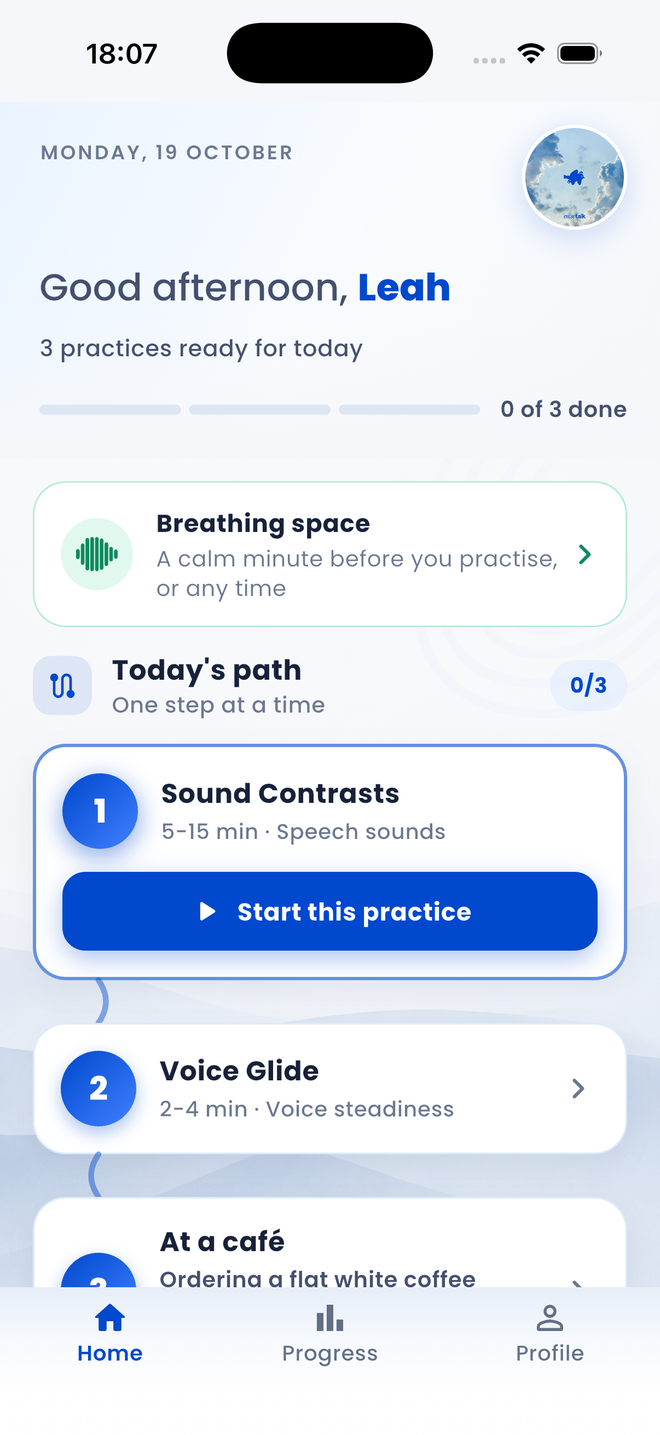
The EaseTalk home screen on a phone, showing today's assigned practice as a single card with a start button.

Today's practice, one card at a time.

Built and backed at

Named by Enterprise Ireland among 15 healthcare AI innovators to watch for 2026.

The gap between appointments

Therapy should not go quiet between sessions.

Most of the week happens away from the clinic. That is where speaking actually gets tested, and it is the part a therapist has never been able to see.

  • Long gaps, short sessions

    Time with a therapist is limited. What happens in the days in between shapes how much of it holds.

  • Home practice is hard to start

    A sheet of exercises rarely tells you what to say, to whom, or when to stop. Practice quietly stops happening.

  • The therapist is working blind

    Sessions often begin by reconstructing the fortnight from memory, which costs time that could go to therapy.

An illustration of a person sitting on the floor, cross legged, holding a phone.

Practice scenario

Ordering a flat white at a café

What practice feels like

Somewhere to get it wrong in private.

A real situation to talk through, at your own pace, with nobody waiting on you and nowhere to be. You can repeat it as often as you like, and you can stop whenever you want.

You always see What we heard, the words the app detected, so if it gets you wrong you can see that it got you wrong. Nothing is scored against you, and there is no streak to protect.

How it works

Four steps, with your choice at the centre.

  1. 1

    Your therapist assigns the practice

    They choose what matches the work you are doing together, from their own portal.

  2. 2

    You practise at home

    Open the app, see today's practice on the home screen, and start when you are ready.

  3. 3

    You choose whether to mark it complete

    When you finish, you decide whether to mark the assignment as completed. EaseTalk does not decide this for you.

  4. 4

    Your therapist sees the status you selected

    They see only whether you marked it complete—not a recording, transcript, score, or analysis of what you said.

Only your completion choice is shared

You choose whether to mark an assignment as completed. That patient-selected status is the only practice information shown in the therapist portal. Your therapist does not receive your recording, transcript, speech-recognition result, score, or an analysis of the conversation.

Two connected experiences

One platform. Two connected experiences.

The app and therapist portal stay in step, so every practice connects back to your care.

For you, in the app

  • Open your assigned practice
  • Rehearse real conversations
  • Choose whether to mark it complete
A person practising speech with the EaseTalk app on their phone.
keeps you connected
A therapist assigning practice from the EaseTalk portal on a laptop.

For your therapist, in the portal

  • Assign personalised practice
  • See the status each patient selected
  • No monitoring, scoring, or diagnosis
See the therapist side
Being straight about the AI

What the AI does, and what it does not do.

EaseTalk uses AI to play the other side of a conversation. That is the whole of its job.

It plays the other side

The AI responds during a practice conversation so you can rehearse privately. It does not assess your speech or create a report for your therapist.

It does not diagnose or treat

It makes no assessment, gives no treatment advice, and takes no decision about your care. EaseTalk is not a medical device.

It does not monitor you

EaseTalk does not use the conversation to track symptoms, measure clinical progress, or decide whether the practice was successful.

Speech recognition gets things wrong

Speech systems are trained mostly on typical speech, so they mishear atypical speech more often. That means the people EaseTalk is built for are the people most likely to be misheard. This is why every practice shows you What we heard, and why a mishearing is never quietly treated as a mistake you made. How we handle misrecognition.

An adult supporting a child as they communicate using a tablet.
Our ethos

Communication over perfection.

The goal is not flawless speech. It is being understood, and feeling able to start the conversation in the first place.

So there is nothing here that shouts at you. No streaks to protect, no leaderboards, no red warning states for a quiet week. Progress moves at the pace you move at.

Join the waitlist

Places open gradually while we are still in pilot. Add your name and we will come back to you when one opens, whether you want to practise yourself or run EaseTalk in your service.

The button opens your own email app with a short message ready to send. You can also write to easetalkai@gmail.com.

Keep practice connected to care.

EaseTalk is in clinical pilot, and access runs through the therapists we work with. If you would like to use it, or to talk about running a pilot in your service, we would like to hear from you.