

Extend practice beyond the therapy room.
Assign structured exercises and real world speaking practice from one connected platform, while clinical decisions stay where they belong: with you.
Current pilot · therapist portal displays patient-selected completion
App screens shown in English.
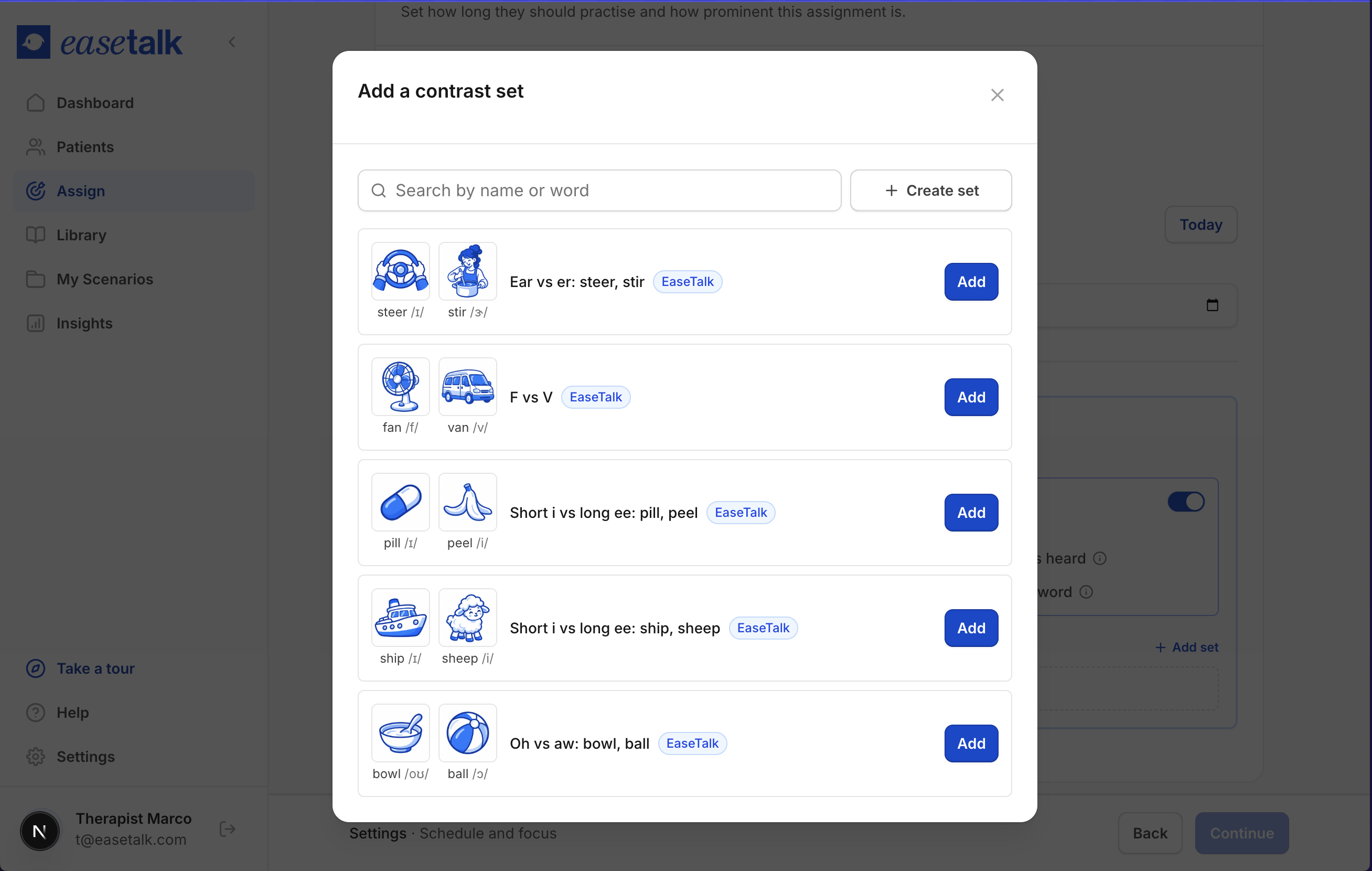
Deliberately narrow.
The portal has two jobs: deliver the practice you assign and show the completion status the patient chose to submit.

-
Assign practice
Choose what matches the work you are already doing with a patient. It appears on their home screen as today's practice.
-
See the status the patient chose
The portal displays whether the patient marked an assignment complete. EaseTalk does not verify that status or infer it from their activity.
Not a medical tool. Not patient monitoring.
EaseTalk does not observe a patient's condition or replace the clinical relationship. Assessment, diagnosis, and care stay entirely with qualified professionals.

EaseTalk cannot be used to monitor or diagnose patients
EaseTalk is not a medical device. It does not monitor symptoms, assess, diagnose, screen, triage, verify adherence, or measure clinical outcomes. A patient-selected completion mark must not be used as the basis for a clinical decision. EaseTalk is not a crisis or emergency service.
What EaseTalk does
- Delivers the practice you assigned, in a structured form.
- Shows your patient the words it detected, so errors are visible to them.
- Lets the patient choose whether to mark an assignment complete.
- Shows that patient-selected status in the therapist portal.
What EaseTalk never does
- Produce a diagnosis or a clinical impression.
- Recommend or change a course of treatment.
- Monitor symptoms, risk, adherence, or clinical progress.
- Verify that a patient carried out the assigned practice.
Treat completion as a patient-reported administrative status only. It is not evidence of adherence, clinical outcome, progress, or risk, and it must not replace your own assessment or clinical record. Read how we think about this.
What you can see, and what you cannot.
The therapist portal shows one piece of practice data: the completion status the patient chooses to submit. Nothing about their conversation or performance is made available to you.
The only visible practice data
The status the patient selected for each assignment: marked complete or not marked complete. This is the only practice data served to the therapist portal.
Selected, not detected
The patient chooses the status themselves. EaseTalk does not infer completion from app activity, conversation content, speech recognition, or performance.
Never visible
Audio, transcripts, detected words, scores, reflections, progress summaries, confidence or difficulty patterns, and any analysis of the practice conversation.
Where the data lives
The question most services ask first
-
Stored in the EU
Account, assignment, and patient-selected completion data sit in Microsoft Azure's West Europe region in the Netherlands, with backups in Sweden Central. Both are inside the European Union.
-
The AI runs inside the EU too
Language models run on Azure AI Foundry, and speech recognition on Azure, in West Europe or Sweden Central depending on where capacity is available. Both are inside the EU. Your patients' content is not used to train the underlying models.
-
Encrypted, and kept for three years
Data is encrypted in transit and at rest. Retention is three years, or sooner if a patient asks us to delete their account.
Speech transcripts are health data
A transcript of somebody receiving speech and language therapy is special category data under Article 9 of the GDPR. We treat it that way, we name every processor rather than describing them as industry standard partners, and we say which country each one runs in. It is all in the privacy policy, and it is worth a read before you recommend EaseTalk to a patient.
Building a richer picture of practice.
We are exploring how speech technology can turn practice activity into clear, reviewable information for clinicians, without making the clinical decision for them.
A closer look at speech sounds.
Practice recordings and sound-by-sound insights are in development. This preview is separate from the completion status shown in the current pilot.
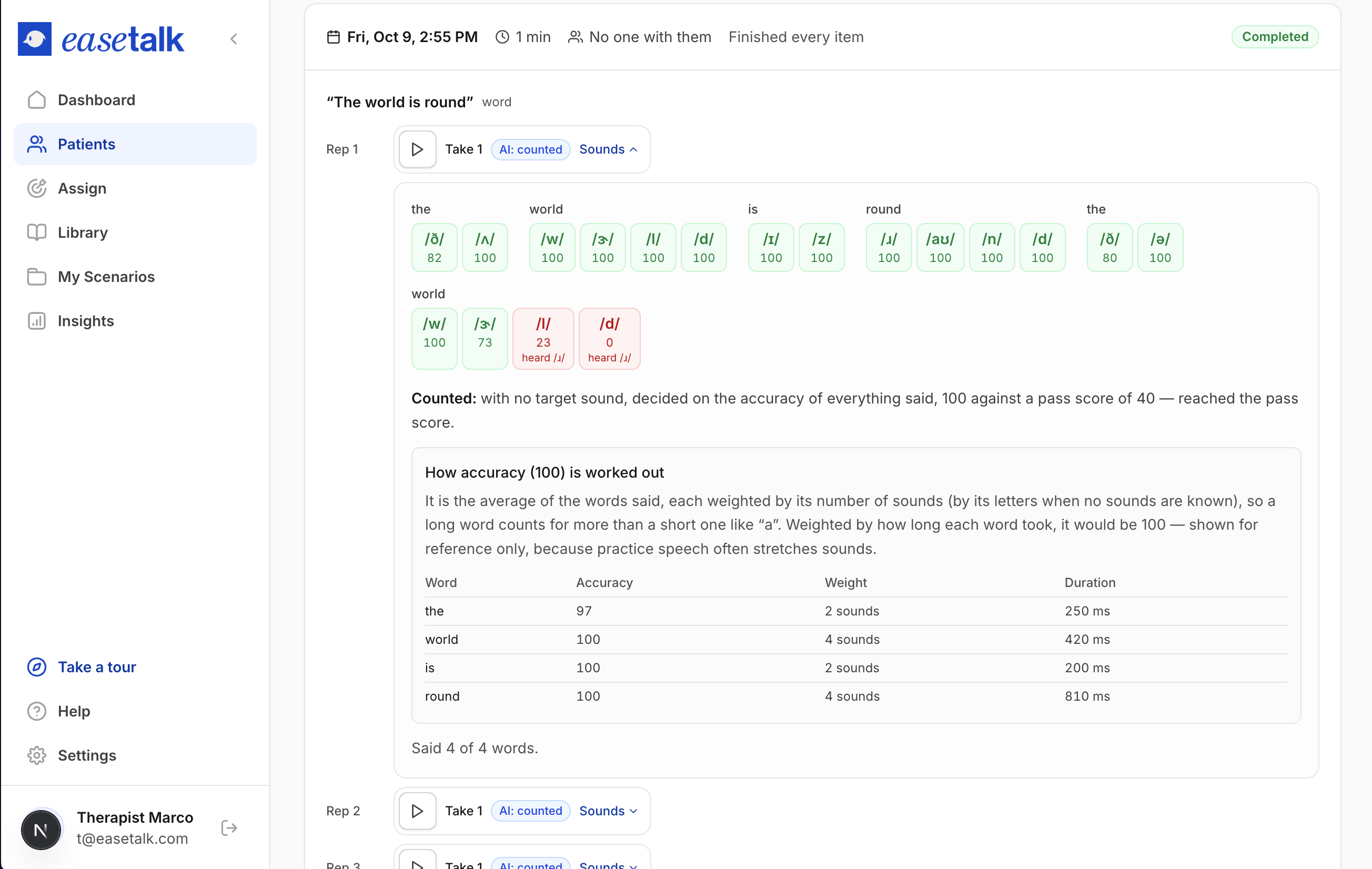
Explore the trends prototype
Scroll the prototype sideways to read it
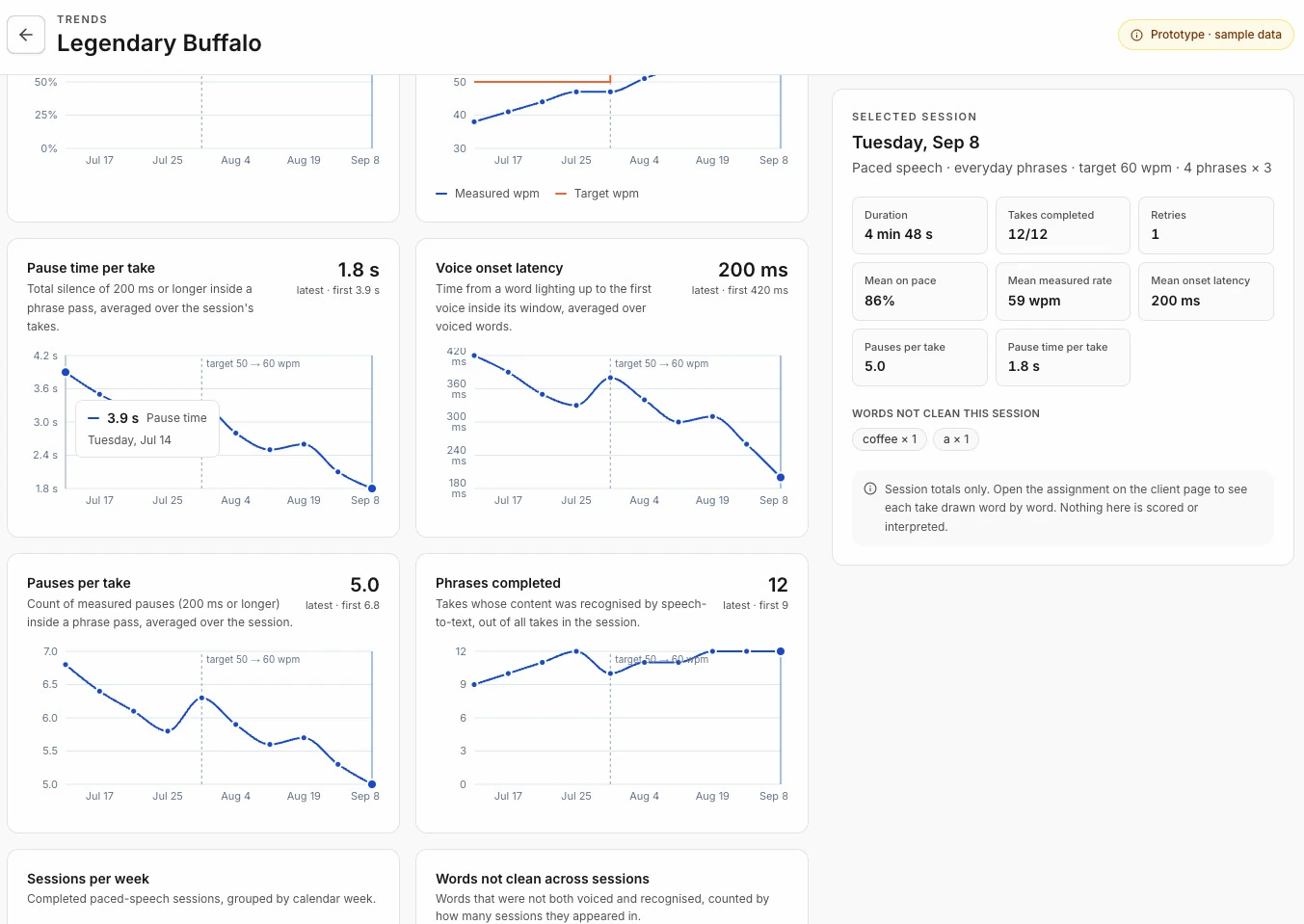
-
Observe
Surface measurements captured during structured practice.
-
Understand
Help clinicians inspect patterns and context across sessions.
-
Decide
Interpretation and clinical decisions remain with the speech and language therapist.
We are in clinical pilot, and we say so.
EaseTalk was built at University College Cork with the Speech and Language Therapy department, with practising therapists, and with people who live with speech difficulty. Early clinical pilot activity has taken place at South Infirmary Victoria University Hospital in Cork.
Pilot means the product is still changing, that some features arrive before others, and that your feedback moves the roadmap. Taking part is voluntary, for you and for your patients.
Enterprise Ireland named EaseTalk among 15 healthcare AI innovators to watch for 2026.

Built with UCC Speech and Language Therapy

HIHI AI Call 2025 winner

New Frontiers, Phase II Best Pitch Award
NDRC partnership
Bring your questions.
Clinical governance, data protection, and what happens when the recogniser is wrong. Those are the right questions to ask, and we would rather answer them before you use it than after.